‹ Backhigh-NA EUV

high-NA EUV

ASML
2026-09-08 06:51:28

ASML to Develop New Solutions for Advanced Chip Manufacturing, Targeting 2033 Mass Production

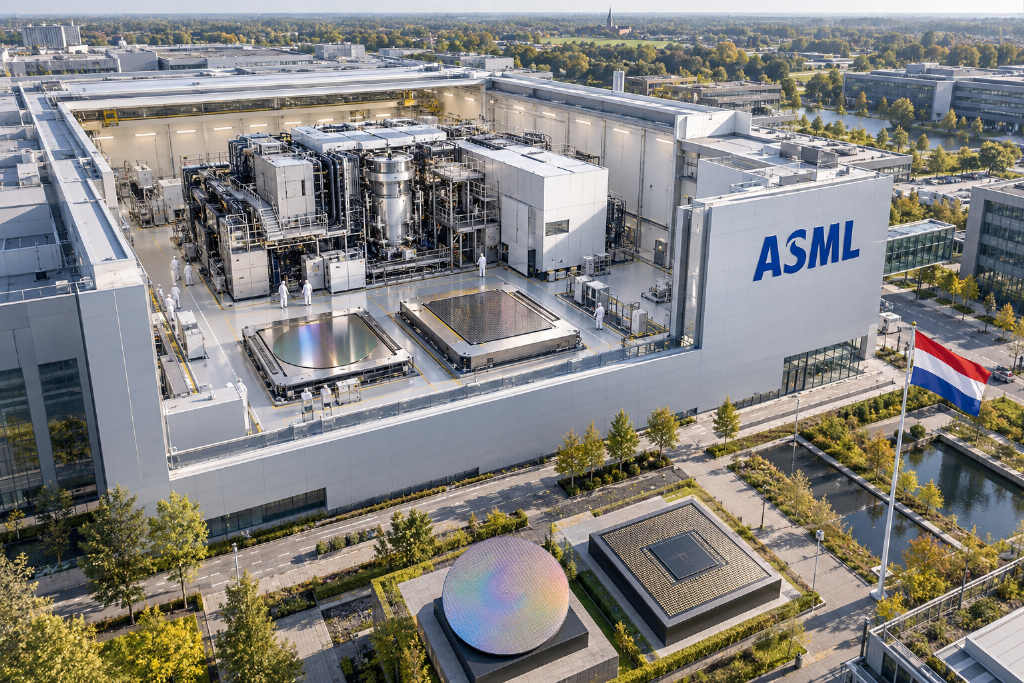
ASML announced plans to collaborate with key customers on new solutions to produce cutting-edge chipmaking equipment, aiming to meet demand for large data center chips designed by companies like NVIDIA. Its current EUV lithography systems can produce chips up to 800 square millimeters, while the next-generation high-NA EUV tools offer finer resolution but are limited by smaller reticle sizes. ASML targets a pilot line with larger reticles by 2031 and mass production by 2033.

800
ASML to Develop New Solutions for Advanced Chip Manufacturing, Targeting 2033 Mass Production
Elon Musk
2026-08-12 12:25:08

Musk’s TeraFab fuels new scrutiny of FEL as a possible lithography challenger

Elon Musk’s TeraFab chip manufacturing plan has moved from a compute-supply story into a lithography debate after speculation that the project may be aligned with a free-electron laser, or FEL, approach to extreme ultraviolet light sources. The discussion gained momentum after Musk posted 「FEL FTW」 on social media, a remark that many read as support for the idea. The core issue is whether FEL can attack one of the most entrenched positions in the semiconductor equipment business: ASML’s dominance in EUV lithography. The article lays out why that question is drawing attention now. ASML’s laser-produced plasma, or LPP, light source enabled commercial EUV, but its limits are becoming more visible as the industry pushes toward 2 nm and below. Conversion efficiency remains low, tin debris contaminates costly mirrors, and power requirements keep rising. FEL backers argue their approach avoids plasma conversion, removes tin-droplet contamination, and could deliver much higher EUV output. xLight, which raised an oversubscribed $40 million Series B in July last year and later brought in former Intel CEO Pat Gelsinger as executive chairman, says its system could sharply raise fab productivity. Even so, the broader field remains mixed. ASML is still expanding EUV and DUV output, advancing High-NA EUV, and posting rising sales and profit. At the same time, alternative paths including X-ray lithography, nanoimprint lithography, and electron-beam direct write are also developing, each with different trade-offs in cost, throughput, and manufacturability.

5150
Musk’s TeraFab fuels new scrutiny of FEL as a possible lithography challenger
Elon Musk
2026-08-09 05:35:07

Musk reply fuels fresh talk over FEL as an alternative EUV lithography light source

A discussion sparked by TeraFab-related information and a reply from Elon Musk has revived attention on free-electron laser, or FEL, technology as a possible alternative to conventional extreme ultraviolet, or EUV, lithography light sources. The source article stresses that the claim remains speculative and does not confirm Musk’s actual plans, but argues the technical route is worth examining on its own terms. It lays out how FEL systems work, starting with high-energy electron beams from particle accelerators, then using periodic magnetic structures known as undulators to generate tunable, coherent, high-intensity light across a range that can theoretically extend from soft X-rays through EUV and beyond. The piece also points to U.S. startup xLight as a notable supporter of this direction and notes that former Intel CEO Pat Gelsinger is now xLight’s executive chairman. According to the article, xLight says its FEL source can deliver up to four times the EUV power of current LPP systems, lower wafer costs by about 50%, support as many as 20 ASML systems, and operate for up to 30 years. At the same time, the article makes clear that stronger source physics does not automatically translate into better manufacturing readiness. FEL systems still face major hurdles in size, cost, stability, uptime, and integration with lithography optics, leaving today’s engineered EUV sources more suitable for high-volume fabs at this stage.

1730
Musk reply fuels fresh talk over FEL as an alternative EUV lithography light source
Intel
2026-07-24 01:00:01

Intel reports $16.1 billion in Q2 revenue as data center sales jump 59%

Intel reported revenue of $16.1 billion for the second quarter of 2026, up 25% year over year and ahead of the $14.42 billion analyst consensus tracked by LSEG. On a non-GAAP basis, the company posted net income of $2.2 billion, or $0.42 per share, compared with a loss a year earlier and above the $0.21 per-share estimate. The standout segment was Data Center and AI, which generated $6.3 billion in revenue, up 59% from a year ago, as CEO Lip-Bu Tan said CPU demand in data centers is "taking off" and running ahead of supply. Intel also said it has signed 10 long-term agreements of that kind while operating under supply constraints. Foundry revenue rose 31% to $5.8 billion, though the unit remained in an operating loss due in part to internal manufacturing activity. Intel also disclosed Fortinet as the first publicly named customer for its foundry business. Looking ahead, the company raised its 2026 capital spending plan to $20 billion from $18 billion and issued third-quarter guidance above Wall Street expectations, including revenue of $15.8 billion to $16.8 billion, non-GAAP EPS of $0.38, and gross margin of about 42%.

1880
Intel reports $16.1 billion in Q2 revenue as data center sales jump 59%